bluename
 How to Identify Fast-Growing vs. Slow-Growing Cactus Species: A Grower's Guide
I’ve killed my fair share of cacti. There, I said it. My biggest mistake wasn’t overwatering or insufficient light—it was misunderstanding their fundamental nature. I’d buy a cute, plump cactus, expecting it to fill a pot within a year, only to stare at the same plant, seemingly unchanged, seasons later. Frustration led me to ask: was I doing something wrong, or was this just its pace? That’s when I realized the critical first step every enthusiast misses: learning how to identify fast-growing vs. slow-growing cactus species. This knowledge transforms your care routine and sets realistic expectations. Over the past two weeks, I systematically observed my collection, applying key identification principles, and the differences became stunningly clear.
Understanding growth rates isn't just about patience; it's about tailoring your care. A fast-growing species given slow-growing care (like a too-small pot or infrequent feeds) will be stunted. Conversely, treating a slow-grower like a fast one is a recipe for rot. Let me walk you through the exact steps I took to categorize my plants, the two-week observations that confirmed my theories, and the pitfalls I navigated along the way.

The Core Visual Cues: What to Look For First
You can often tell a cactus's growth potential before you even buy it. I started my project by examining morphology—the physical form and structure.
Stem and Areole Patterns Fast-growing cacti, like many Cereus, Trichocereus, or Opuntia species, typically have greater spacing between their areoles (those fuzzy bumps where spines, hairs, and flowers emerge). The stem segments or columns elongate more quickly, creating more distance. In my two-week observation, my Cereus peruvianus added a noticeable 1.5 cm of new, bright green growth at its tip. In contrast, slow-growers like Astrophytum (Star Cactus) or Lophophora (Peyote) have tightly clustered areoles. My Astrophytum myriostigma showed zero visible stem expansion; growth was imperceptible, focused internally.
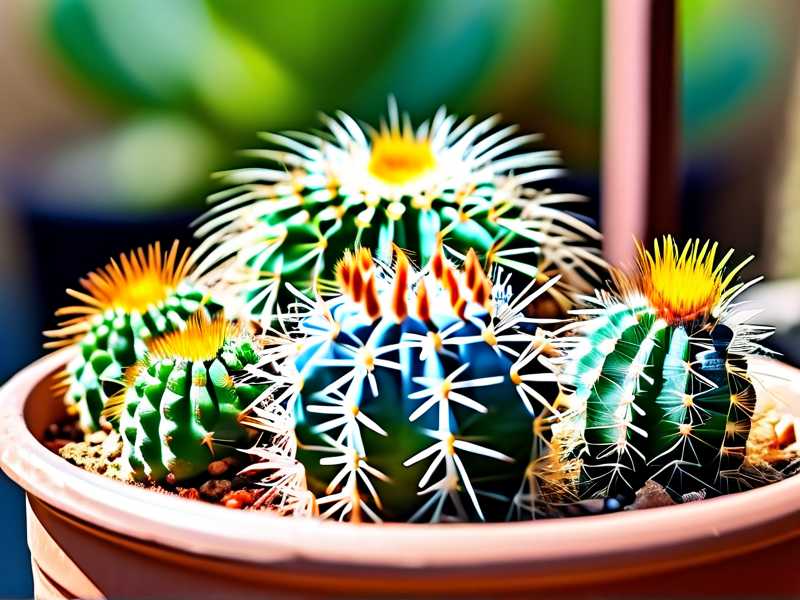
Spine Density and Rigidity This was a revelation. I noticed my fast-growing columnar cacti often have fewer, more flexible spines. They invest energy in vertical growth first. Slow-growing species, especially those native to harsh, exposed environments, frequently sport dense, rigid, and sometimes formidable armor. My Ferocactus (a moderate to slow grower) has hard, hooked central spines—it's built for long-term defense, not rapid ascent. As noted in resources from the Royal Horticultural Society (RHS), such heavy armament is an evolutionary adaptation to protect precious, slowly accumulated water stores over decades.
Root System Reconnaissance
You must get your hands dirty. Gently unpotting a few of my established plants (during their active growth period) provided undeniable evidence.
Fibrous vs. Taproot Dominance Fast-growing cacti tend to develop extensive, fibrous root systems that spread out relatively quickly to support rapid water and nutrient uptake for new growth. My Echinopsis subdenudata had a network of white, hair-like roots filling the pot. Slow-growing species, particularly desert globular types, often prioritize a deep, thick taproot. This acts as an anchor and a massive water reservoir. My Copiapoa, a notoriously slow Chilean genus, had a carrot-like taproot that dwarfed its small surface body. Repotting these requires deep pots, not wide ones.
The Two-Week Growth Test: A Practical Experiment
Theory is good, but proof is in the pudding. I selected three cacti: a suspected fast-grower (Trichocereus pachanoi), a suspected slow-grower (Sulcorebutia rauschii), and a middle-ground Mammillaria. I marked their current height and girth with a non-toxic marker and took dated photographs.
Documenting Visible Change Every three days, I examined them under consistent morning light. The Trichocereus showed a pale green ring of new tissue at its apex within just five days. By day 14, this ring had darkened and expanded approximately 2 mm vertically. The Sulcorebutia showed no change in body size. However, using a jeweler's loupe, I spotted tiny new spines developing at the crown—growth was happening, but on a microscopic scale. The Mammillaria had produced a few new small tubercles. This test cemented the difference between fast and slow growing cacti: for some, change is weekly; for others, it's seasonal or annual.
The Pitfall I Encountered: The "Sleeper" Species My biggest mistake was initially classifying all globular cacti as slow. My Gymnocalycium mihanovichii (Moon Cactus) surprised me. While the colorful grafted top is slow, the green Hylocereus rootstock underneath was producing new stems at a rapid clip! I had to carefully remove the plant from its decorative pot to see this. The lesson: always check the base and rootstock of grafted plants, as they can exhibit two wildly different growth rates in one pot.
Leveraging Growth Knowledge for Perfect Care
Identifying the rate allows you to customize care, a principle emphasized by the American Horticultural Society of America (AHSA) in their guides on xerophyte cultivation.
Watering and Feeding Schedules My fast-growing Trichocereus now receives water weekly during summer heat and a half-strength balanced fertilizer bi-weekly. It drinks it up and pushes growth. My slow-growing Astrophytum stays on a strict "soak and dry" cycle, going 3-4 weeks between waterings in summer, and receives fertilizer only once at the start of the season. Treating them the same would doom one of them.
Potting and Repotting Rhythms Fast-growers might need repotting every 1-2 years as they outgrow containers. I repotted my Cereus after this experiment because I saw roots circling the bottom. Slow-growers can happily reside in the same pot for 4-5 years or more. Their repotting is more about soil refreshment than space. Using a well-draining mix is non-negotiable for both, but I add a bit more organic matter for the fast-growers to support their energy needs.
Commonly Asked Questions
Can I make a slow-growing cactus grow faster? You can optimize conditions, but you cannot fundamentally change its genetics. Providing more light, appropriate warmth, and perfect watering during its growing season will support its maximum natural pace. However, over-fertilizing or overwatering in an attempt to speed it up will almost certainly lead to rot and death. Respect its innate rhythm.
Are all columnar cacti fast growers? While many are, it's not an absolute rule. The iconic Carnegiea gigantea (Saguaro) is columnar but incredibly slow, taking 70 years to develop its first arm. Context like native habitat is key. My rule of thumb: columnar cacti from fertile, less arid regions (like many Echinopsis) tend to be faster than those from hyper-arid deserts.
What is the biggest visual sign of active growth? Look for new, fresh tissue that is a different shade—often brighter, lighter green or even reddish (a sign of new pigment). It appears at the very top of columnar types, as new pads on Opuntia, or as tiny new tubercles/ribs at the crown of globular species. This new growth is also typically softer to the touch and may have smaller, emerging spines.
Identifying whether you have a speedster or a stoic in your collection is the foundation of successful cactus cultivation. It shifts your perspective from impatience to appreciation. You learn to celebrate the subtle, hard-won progress of a slow-grower as much as the vigorous leaps of a fast one. By applying these visual, tactile, and observational techniques—spacing of areoles, root structure, and simple marked tests—you can confidently categorize your plants. This allows you to provide truly individualized care, avoiding the common pitfalls of uniform treatment. Remember, in the world of cacti, time reveals all. Your job is to provide the right stage for their performance, whether it's a sprint or a marathon.